
wollongongrestumping@gmail.com


7 Warning Signs Your Wollongong Home Needs Restumping
Rao Hasnain • April 1, 2026
Signs Help You Know Your Wollongong Home Needs Restumping
If a door in your home has started jamming, or your floors feel slightly off when you walk across them, you might be tempted to blame it on the house getting older. In Wollongong, that's rarely the full story.
The Illawarra region has some of the most challenging soil conditions in NSW. Expansive clay, high rainfall, coastal salt air, and steep hillside terrain all put extra stress on the stumps holding your home up. Most homes built before the 1980s are sitting on timber stumps that are now 40 to 60 years old, and they don't last forever.
The good news is that your home will usually tell you something is wrong well before the damage becomes serious. You just need to know what to look for.
Here are the seven signs that your
Wollongong home may need restumping, and what's actually happening underneath when you see them.
What Are Stumps and Why Do They Fail?
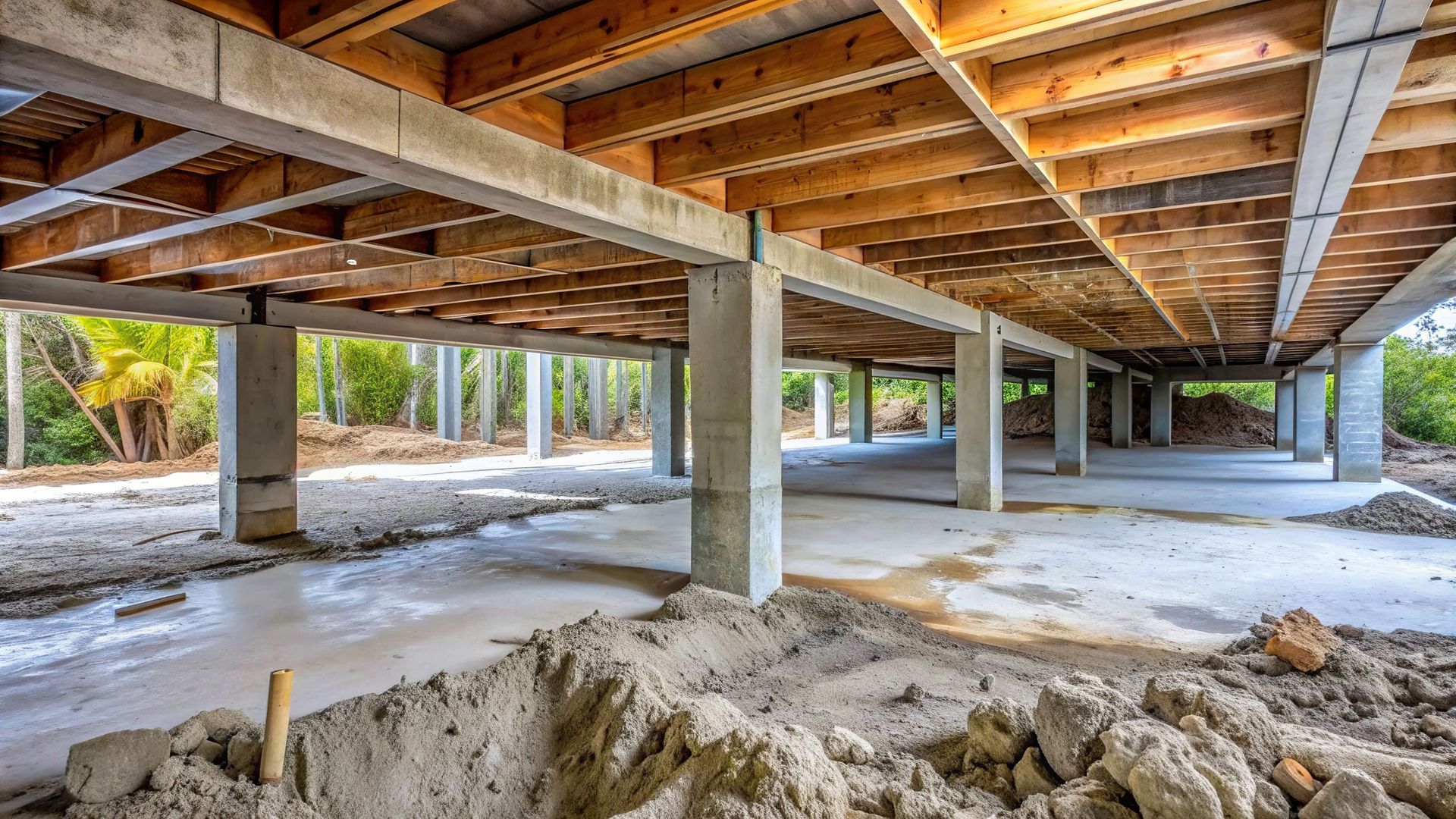
Stumps are the vertical support columns underneath a raised timber floor home. They carry the weight of everything above, your floors, walls, furniture, and roof, and transfer it into the ground.
Timber stumps deteriorate over time. The main culprits in Wollongong are moisture and termites. The Illawarra's high annual rainfall keeps subfloor soil damp for much of the year, and damp timber is exactly the environment where rot and termite activity thrive. Add the clay soils across suburbs like Dapto, Unanderra, and Figtree, soils that swell when wet and shrink when dry, and you have ground that constantly pushes and pulls at your foundation throughout every season.
When stumps start to fail, the floor above them moves. And when the
floor moves, everything attached to it moves too.
Sign 1: Your Floors Feel Uneven or Sloped
This is usually the first thing homeowners notice. One part of the room feels lower than another, or you get a faint sense of walking slightly downhill when you cross a room you've walked across a thousand times before.
How to check: Put a marble on the floor and watch if it rolls consistently in one direction. Or use a spirit level, any reading showing more than 10–15mm of variance across a room is worth taking seriously.
What's happening underneath is that one or more stumps have sunk or rotted to the point where they can no longer keep the floor frame level. In Wollongong's reactive clay areas, this often happens gradually over several years as the ground moves through wet and dry cycles.
Left alone, uneven floors put increasing stress on your wall frames, which eventually shows up as cracks and sticking doors.
Sign 2: Cracks in Walls or Ceilings
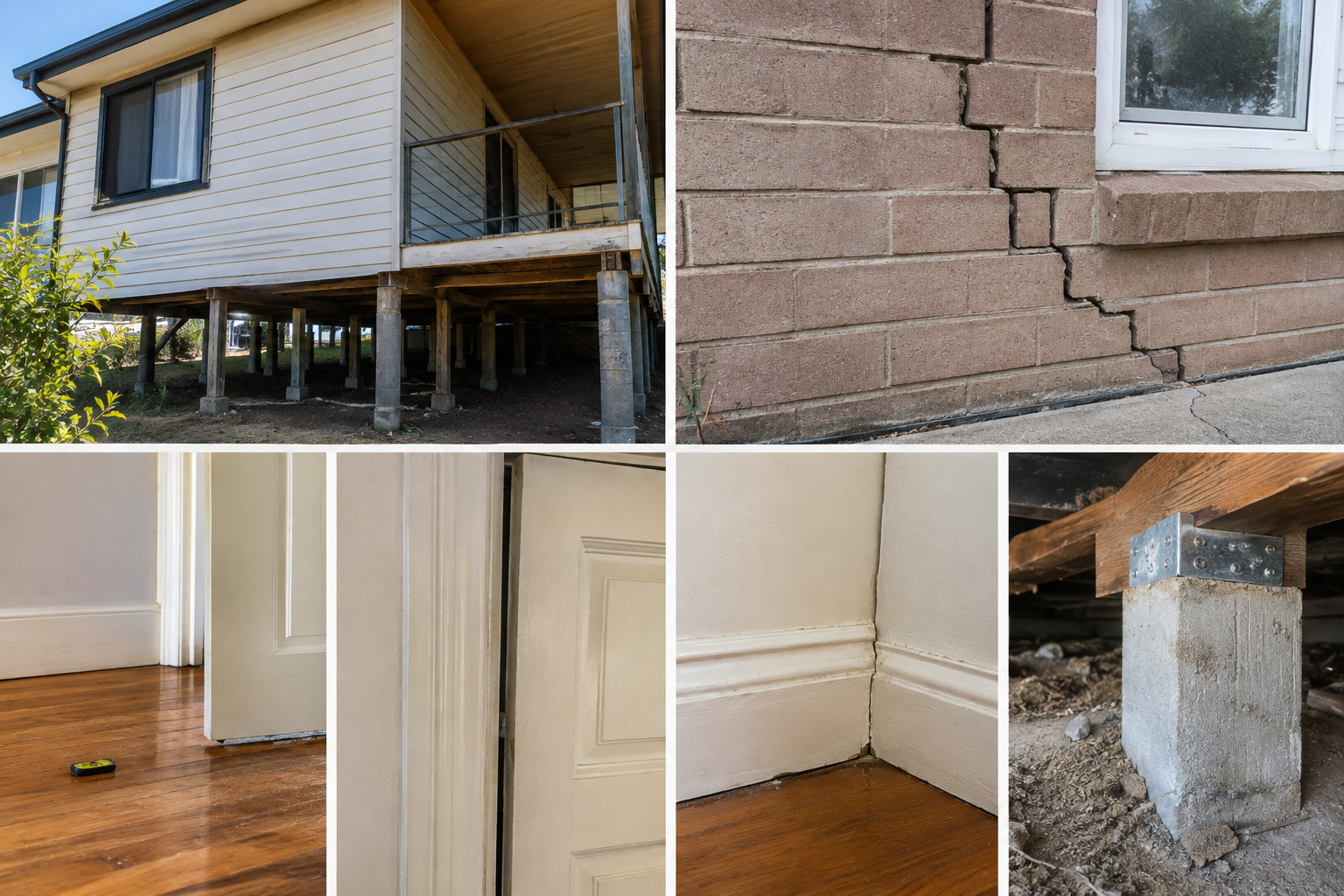
Wall cracks are not always a foundation issue but when they appear in specific patterns, they're hard to ignore. The ones to watch for are diagonal cracks at the corners of door and window frames. These form because when your floor frame shifts, the door and window frames get pulled slightly out of square, and the plaster cracks at the weakest point the corners.
On exterior brick walls, stair-step cracks following the mortar joints are a reliable sign of differential settlement, meaning one part of your foundation is sinking more than another.
Any crack you can fit a coin into, or one that has visibly grown over the past few months, needs a professional look. In Wollongong, cracks often appear or worsen after prolonged wet periods, when the clay soil has expanded significantly beneath the house.
Sign 3: Doors and Windows Sticking or Jamming
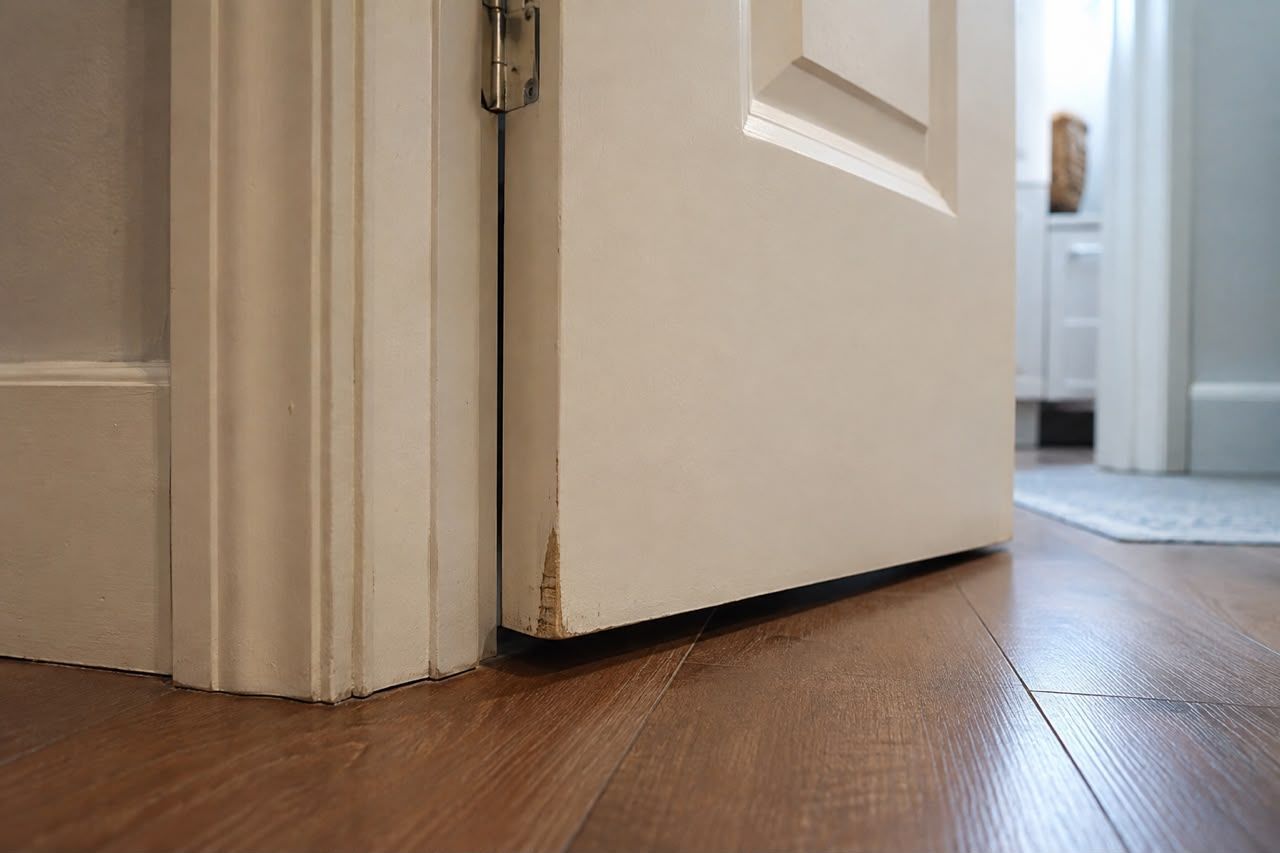
A door that used to swing freely and now catches on the frame, or a window that's become hard to open, is often brushed off as "just the humidity" or "wood swelling in summer." Sometimes that's true. But when multiple doors and windows in different parts of the house start playing up around the same time, it's almost always a foundation issue.
Here's why:
when floor frames shift unevenly, they pull wall frames with them. Even a 2–3mm change in how level a door frame sits is enough to make a door drag at the top or bottom. When the same thing is happening across several door frames at once, the floor has moved, not the doors.
Sign 4: Visible Damage When You Look Under the House
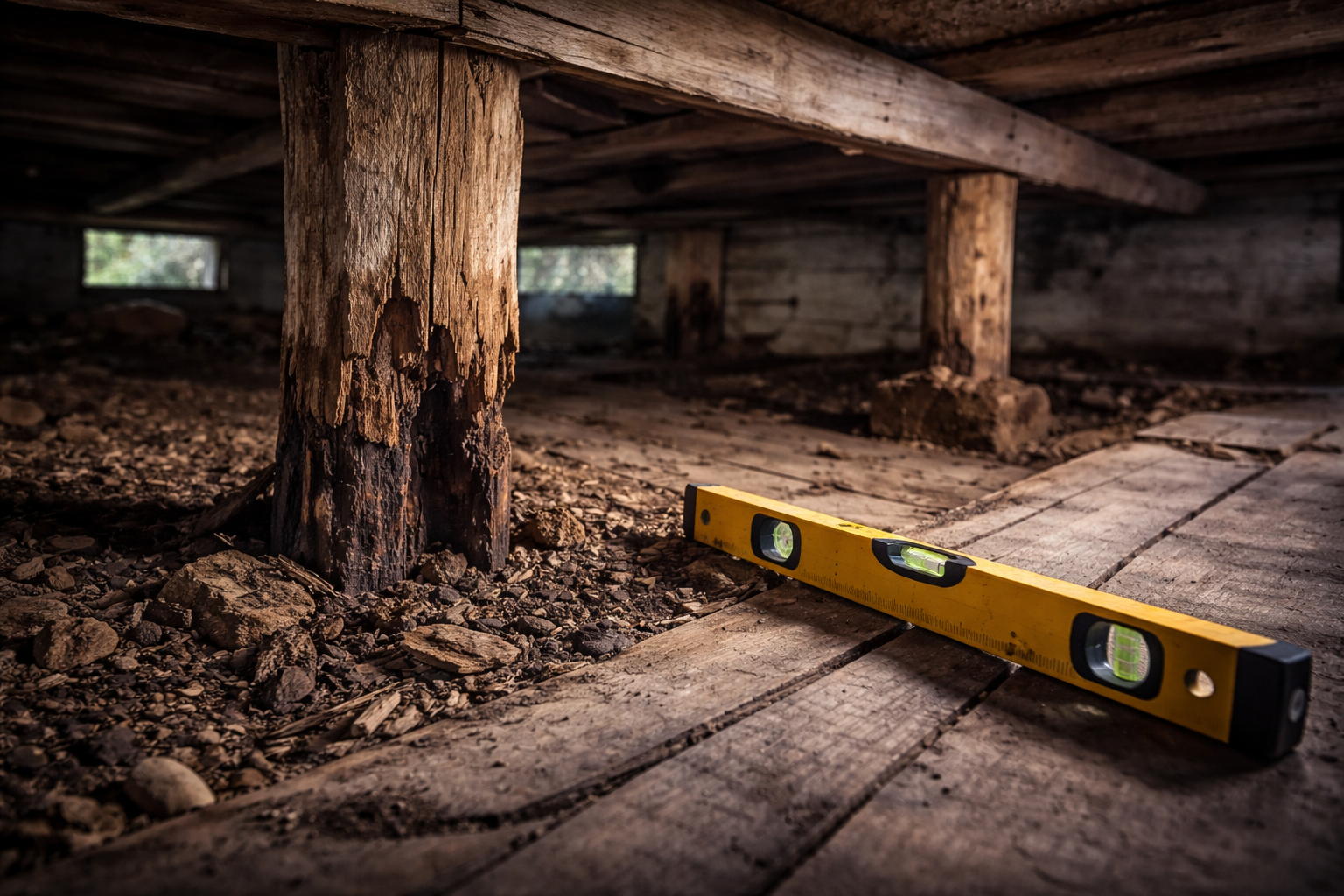
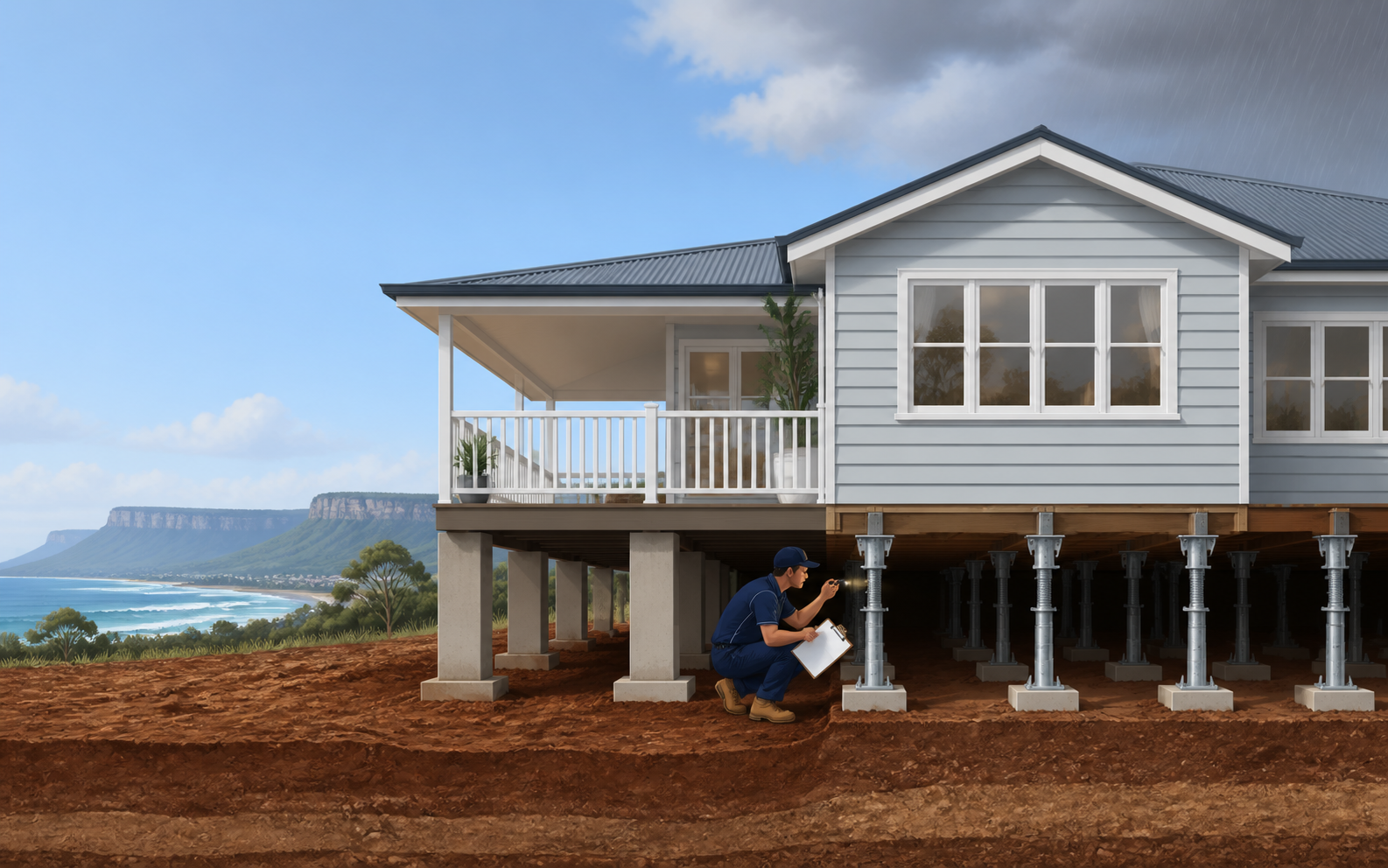
If your home has a subfloor access panel, a torch inspection under the house can tell you a lot.
Signs that stumps need replacing:
- Soft or spongy timber, press a screwdriver into the stump. Healthy wood resists it. Rotted wood gives way.
- Fungal growth or dark staining, active moisture damage.
- Mud tunnels or small holes, classic termite indicators. Wollongong's warm, humid conditions make termite activity particularly common.
- Leaning or tilting stumps, any stump that's no longer vertical has shifted in its footing.
- Rust staining at metal fixings, in coastal suburbs like Woonona, Bulli, and Thirroul, salt air corrodes the metal brackets connecting stumps to bearers.
Also check the base of each stump where it meets the soil. This is where rot almost always starts, because it's the point of constant moisture contact. Dig down a few centimetres with a screwdriver, if the wood is soft at the base, it's likely gone further up than you can see.
Sign 5: Gaps Opening Up Between Walls, Floors, and Ceilings
When different parts of your home's structure start moving at different rates, the joints between them open up.
Where to look:
- The gap between the skirting board and the floor, if you can see daylight or feel a draught along the base of the wall, the floor has dropped relative to the wall.
- Separation at the cornice line where ceiling meets wall.
- Gaps above or below internal door frames.
- Corners where two interior walls meet, if they're cracking apart, the walls are being pulled in different directions.
In Wollongong, these gaps often appear or widen noticeably after a dry summer. When the clay soil contracts, some stumps drop slightly, and the floor moves away from the fixed wall structure above it. Gaps are also practical problems, they let in moisture, cold air, and insects, which creates secondary damage to the surrounding timber framing.
Sign 6: Floors That Bounce or Creak Heavily Under Foot
There's a difference between a floor that's uneven and a floor that's structurally weak. This sign is about the latter. A floor that bounces noticeably when you walk, or that makes a deep cracking sound under load, has lost structural support beneath it. A properly supported floor should feel completely solid, no flex, no bounce.
A simple test: Jump lightly on the spot in the middle of the room, or have someone walk past you quickly. You should feel almost nothing. If the floor visibly flexes or the vibration travels across the room, that's a floor with insufficient support underneath.
This can be caused by rotted bearers or joists, the horizontal timbers that span between stumps, not just the stumps themselves. If joists have deteriorated alongside the stumps, they'll need to be replaced at the same time. Catching it early means less additional work on top of the restumping.
Sign 7: Your Home Is Over 30 Years Old With No Foundation Inspection
If your home was built before the 1990s, has a raised timber floor, and has never had a professional look at the stumps, that alone is reason enough to get an inspection done. Timber stumps installed in Wollongong in the 1960s and 1970s are now 50 to 60 years old. Even in good conditions, most timber stumps have a lifespan of 30 to 50 years.
In Wollongong's moisture-heavy environment, that lifespan is often shorter.
The problem with waiting for visible signs is that stump deterioration starts underground. By the time the rot is showing up as cracked walls and uneven floors above, the stumps have often been compromised for some time.
An inspection costs nothing with a reputable company, takes an hour, and either gives you peace of mind or an early warning while the problem is still relatively simple to fix.
Why Wollongong Homes Are More at Risk Than Most
It's worth understanding why this is a bigger issue in the Illawarra than in many other parts of NSW. The reactive clay soils that dominate the western suburbs of Dapto, Horsley, Unanderra, and Kanahooka swell when wet and shrink when dry. Every wet winter and dry summer causes the ground to move. That cyclic movement puts constant stress on stumps and their footings, which just doesn't exist on stable ground.
Wollongong also receives over 1,200mm of rain per year on average. That keeps subfloor moisture levels high and speeds up timber rot. Poor subfloor ventilation, common in older homes, makes it worse by trapping moisture under the floor.
Coastal suburbs from Thirroul to Shellharbour add salt air into the mix, which degrades both metal fixings and concrete stumps over time.
And in hillside suburbs like Balgownie, Figtree, and Mount Ousley, sloping ground creates uneven load distribution that can overload some stumps while others carry less than their share.
What Happens If You Ignore It?
The damage compounds. A failing stump causes an uneven floor, which distorts wall frames, which creates cracks, which lets moisture in, which rots the joists and bearers above the stumps. What could have been a targeted partial restump of 6–8 stumps becomes a full restump plus bearer and joist replacement.
Partial restumping in Wollongong typically costs $3,000 to $8,000. Full restumping of a standard 3-bedroom home runs from $10,000 to $25,000. If bearers and joists need replacement as well, the total can go higher.
There's also a property value angle. Foundation issues are a required disclosure in NSW. A home with unresolved foundation problems either sells below market value or doesn't sell at all.
Frequently Askes Questions
1. How do I know if my uneven floors are a stump problem or just old floorboards?
Check whether the unevenness is consistent across a whole area of the room rather than isolated to one or two boards. If an entire section of floor slopes in one direction, or a marble rolls consistently when placed on the floor, the issue is foundation movement, not just surface wear. Isolated squeaky or warped boards are a flooring problem. A whole room that feels tilted is a stump problem.
2. Can I just replace one or two stumps instead of doing the whole house?
Yes, partial restumping is a legitimate option if only a small number of stumps are compromised and the rest are in good condition. That said, if your home has original timber stumps from the 1960s or 70s and one has rotted, the others are the same age in the same conditions. A good contractor will be honest with you about whether partial restumping buys you 5 more years or whether you'll be back in 18 months doing the rest anyway.
3. My house is on a concrete slab, does any of this apply to me?
No. Restumping only applies to homes built on raised timber stumps. If your home is on a concrete slab and you're seeing cracks or uneven floors, the relevant service is underpinning or slab repair, a different process entirely. If you're unsure which type of foundation your home has, look through the subfloor access panel or check your original building documents.
4. Will restumping fix my cracked walls and sticking doors, or do I need to repair those separately?
Restumping stops the movement that's causing the damage. In many cases, once the floor is back to level and stable, minor cracks close partially and doors start to swing freely again on their own. However, cracks that have been open for a long time, or doors whose frames have significantly warped, will still need cosmetic repair after the restumping is done. Your contractor should be upfront about this.
5. How much disruption is involved, do I need to move out?
Most homeowners stay in the house throughout the job. The process involves sections of the house being temporarily jacked up, so you'll hear noise and there may be some dust. Your contractor will tell you which areas to stay out of during active lifting. The main inconvenience is that some doors may not function properly while the house is mid-lift, and there may be water or power interruptions for short periods depending on how work is staged.
6. How long do new concrete or steel stumps actually last?
Concrete stumps, when properly installed, are designed to last 50 years or more. Quality steel adjustable stumps carry similar longevity when they're correctly treated against corrosion, particularly important in Wollongong's coastal suburbs. Either way, you are not looking at this job again in your lifetime if the work is done properly with the right materials for your site conditions.
7. Does restumping affect my home insurance or do I need to notify anyone?
You should notify your home insurer before the work begins. Restumping is a significant structural alteration, and some policies require disclosure of structural work. It's also worth checking whether your policy covers any accidental damage that might occur during the process, a reputable contractor will carry their own public liability insurance, but knowing your own coverage is good practice.
8. My neighbour just had their house restumped does that mean mine needs it too?
Not automatically, but it's a reasonable prompt to check. If your homes are a similar age, built by the same era builders, and on the same soil conditions, there's a decent chance they're at a similar stage of stump life. It's worth getting an inspection done while you're thinking about it, especially if you've noticed any of the signs in this article that you've been putting off acting on.
9. I'm buying a house in Wollongong, should I be asking about restumping before I sign?
Yes, absolutely. Ask the vendor directly whether the home has had any restumping done and when. Then book a pre-purchase building inspection with a licensed inspector who will go under the house and check the stumps as part of their report. Foundation issues in NSW are a required disclosure, but that only applies to known issues, a vendor who hasn't checked won't disclose what they don't know. Don't rely on the vendor's disclosure alone.
10. Is there anything I can do to slow down stump deterioration between now and when I can afford to restump?
Yes, improving subfloor ventilation and drainage around the house makes a meaningful difference. Ensure water drains away from the house rather than pooling near the foundation. Clear any debris that's blocking subfloor vents, as good airflow under the floor reduces the moisture levels that accelerate timber rot. These steps won't reverse damage that's already done, but they slow the rate of further deterioration and give you more time before the work becomes urgent.
Ready to work with Wollongong Restumping?
Let's connect! We’re here to help.
Send us a message and we’ll be in touch.
Or give us a call today at 0242026325
Agency Contact Form
More Marketing Tips, Tricks & Tools
Learn why doors suddenly stop closing after foundation movement, from shifting floors to damaged stumps, and when your Wollongong home may need an assessment.
Sagging floors, sticking doors, cracked walls? Here's how to tell if your Wollongong home needs restumping, underpinning, or both.
Compare concrete vs steel stumps for Wollongong homes. Learn which option better suits coastal salt air, reactive clay soil, rainfall and your budget.
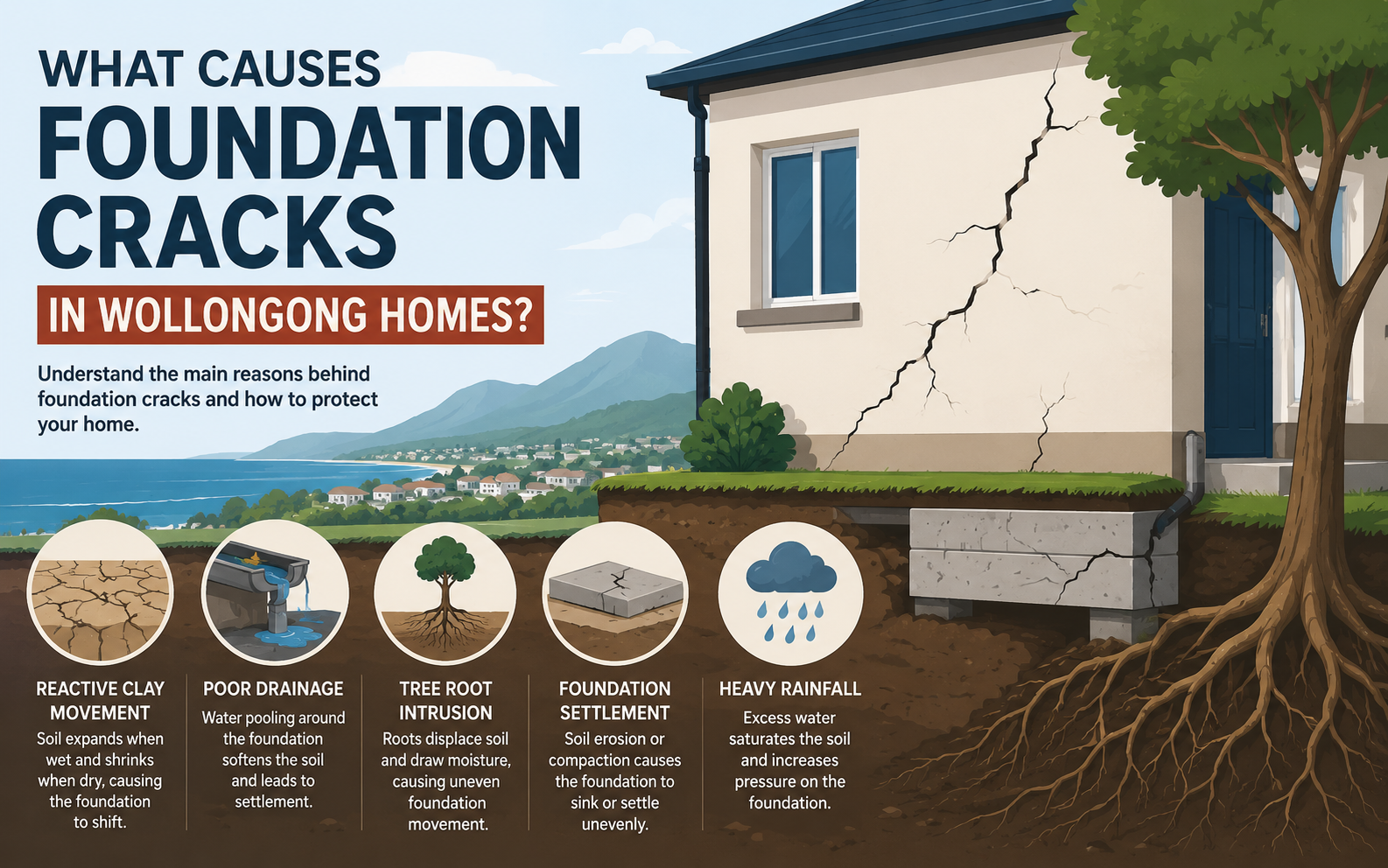
Foundation cracks in Wollongong homes are rarely random. Here's what's causing them, how to read the damage type, and when you need professional repair.
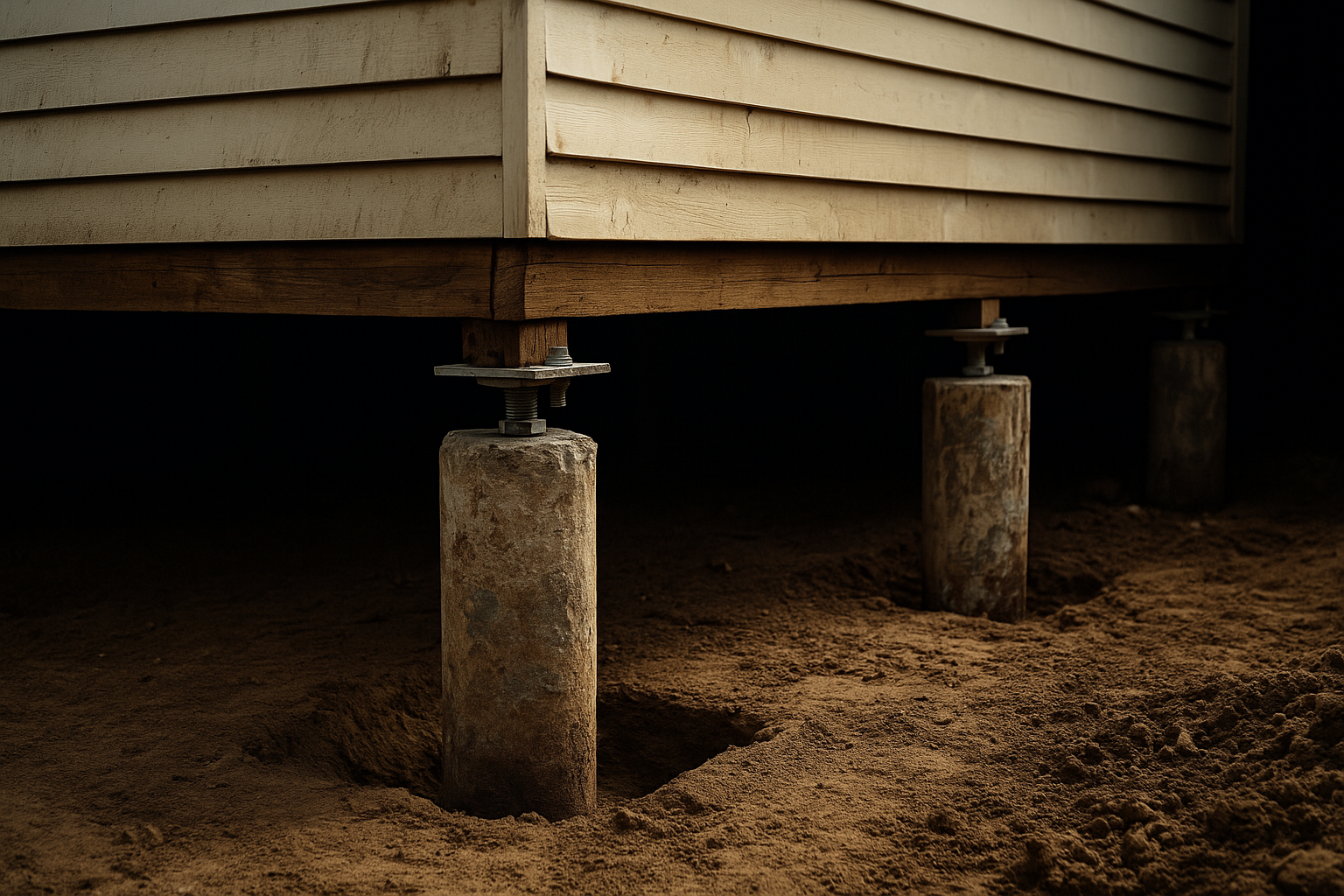
Early foundation repairs prevent structural damage, reduce costly future fixes, and help maintain property value by addressing issues before they worsen.
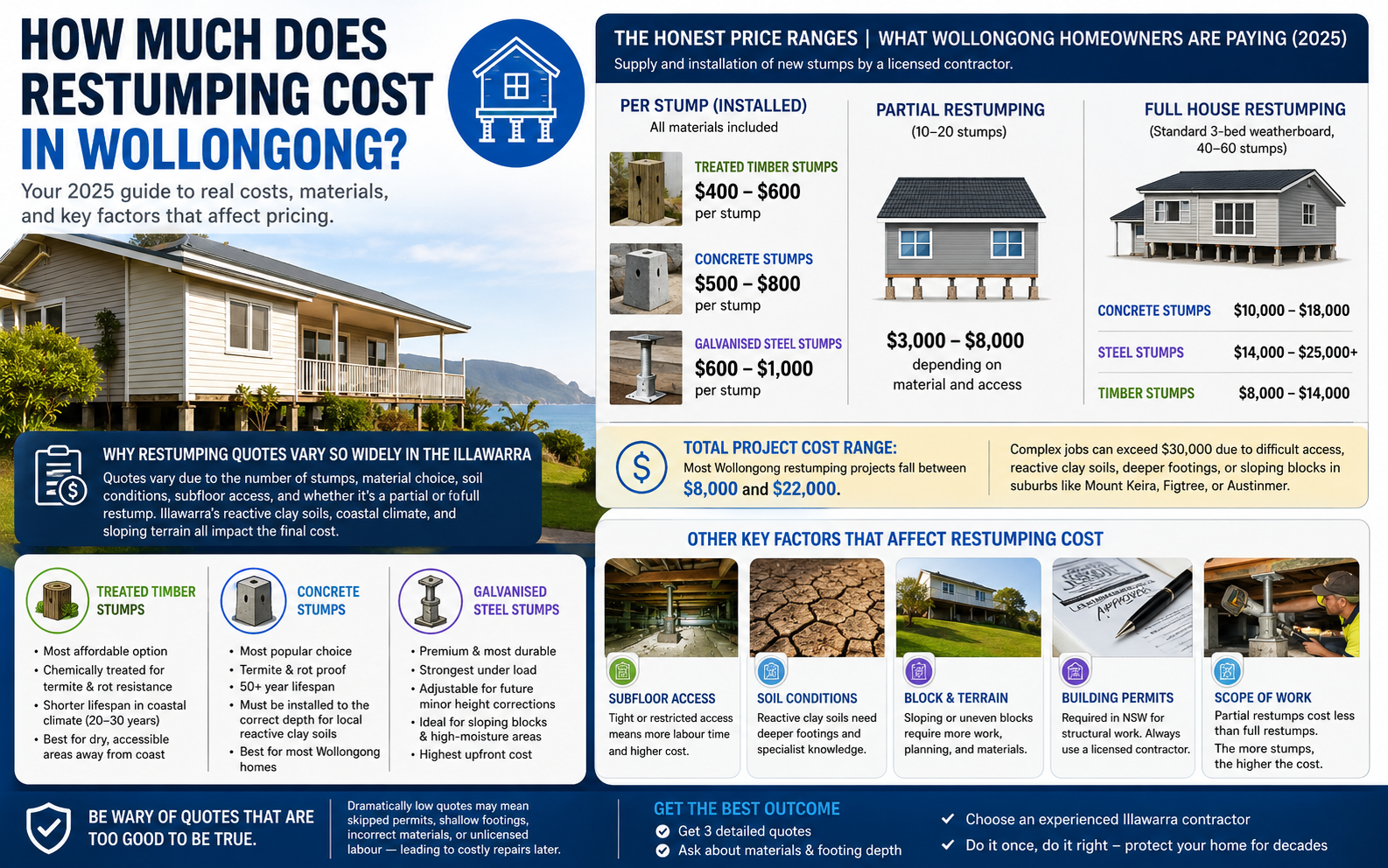
Get accurate restumping costs for Wollongong homes, including per stump pricing, material comparisons, permits, and Illawarra site factors.\

Learn when home insurance may cover restumping or foundation repairs, common exclusions, claim options, and what Wollongong homeowners need to know.
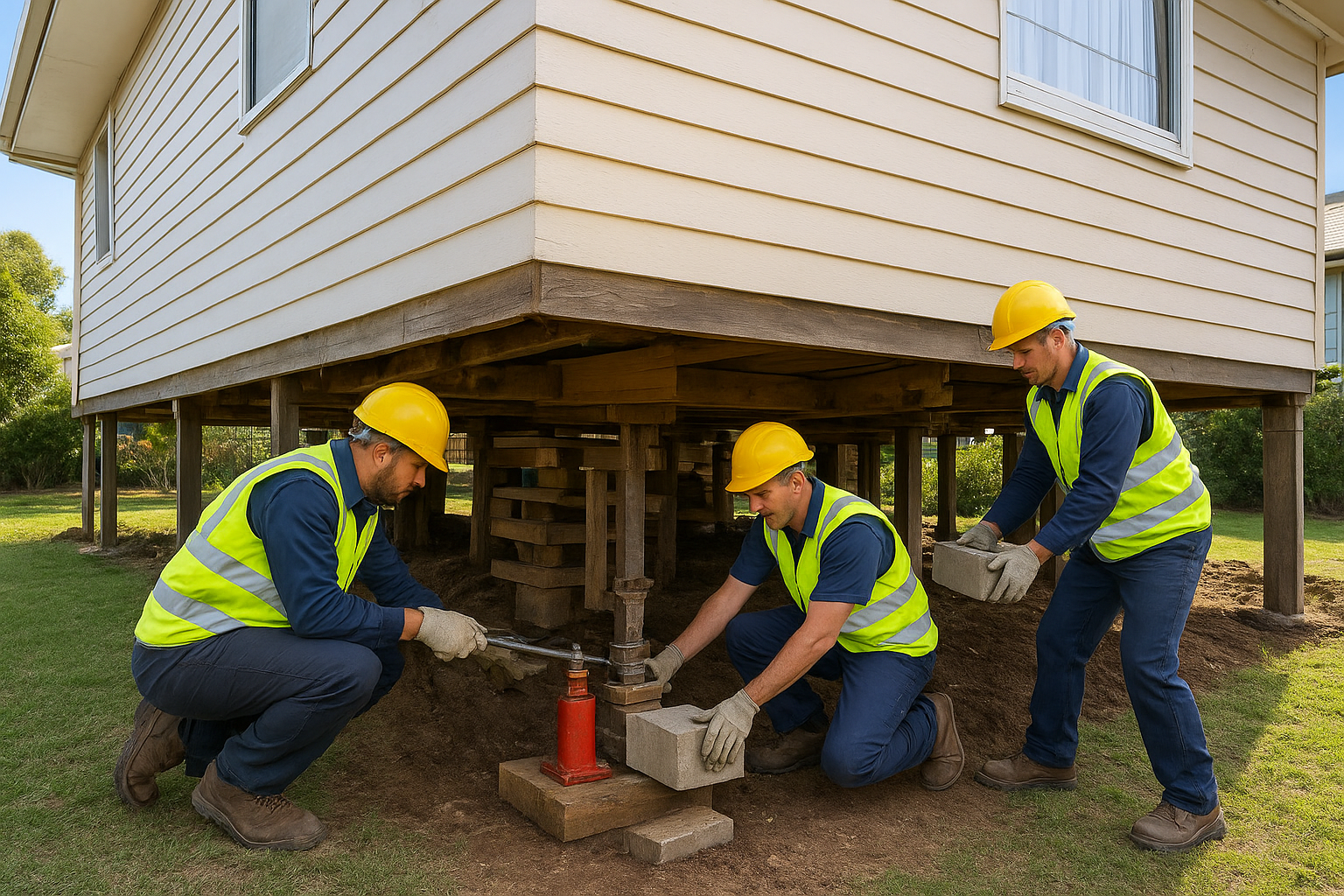
Discover the top 7 common misconceptions about restumping, from costs to structural risks, and learn what homeowners really need to know before starting the process.
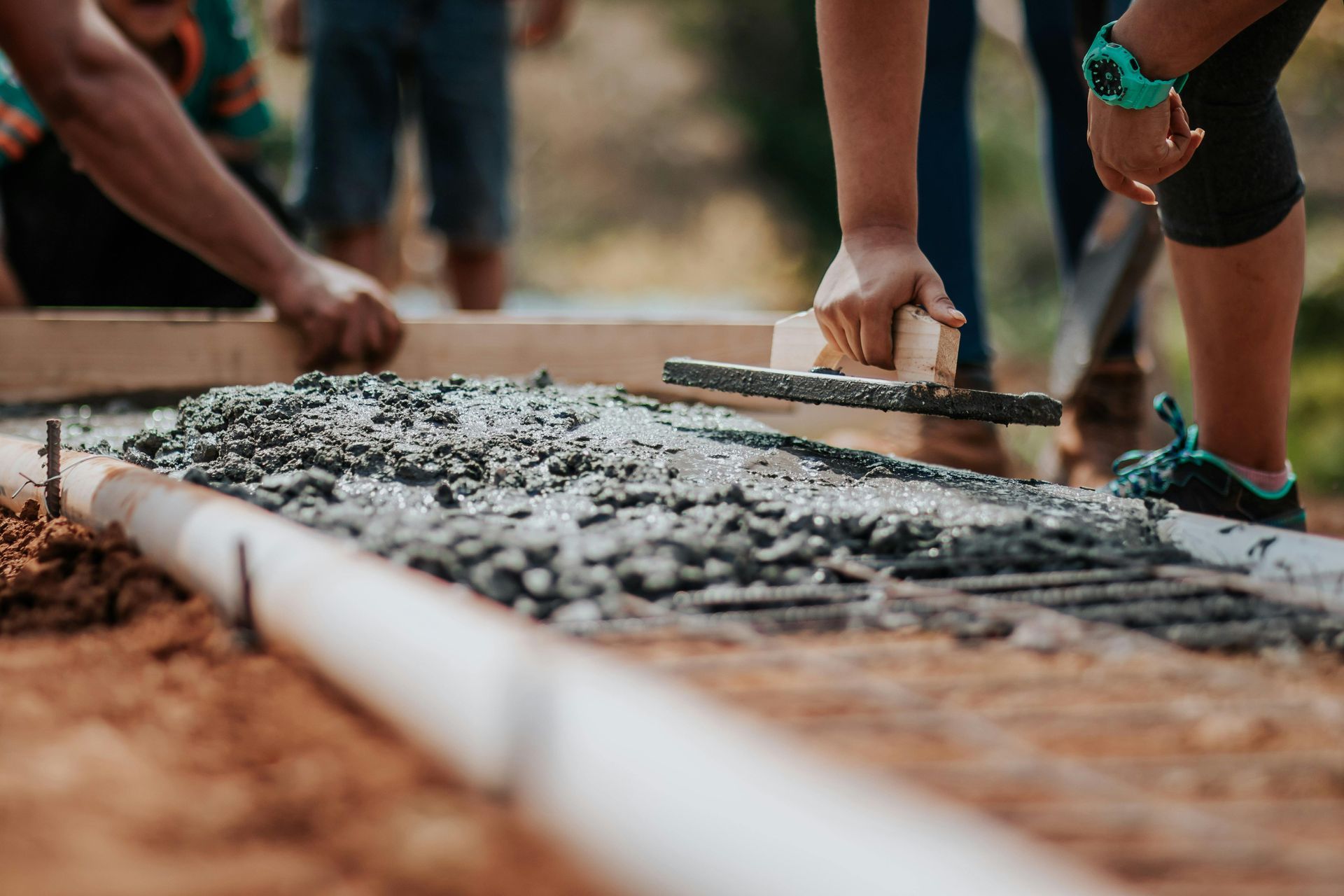
Compare steel and concrete stumps to determine the best option for coastal homes. Explore their durability, resistance to corrosion, and overall suitability.
From road debris to sudden temperature changes, learn the 5 leading causes of rear window damage in Australia and how to avoid expensive repairs.